
Traditional Workflow
- 1-hour inspection
- 2–3 hours writing reports
- Deliver report later
For HVAC Professionals
Suspected mold, accumulated dust, moisture problems, and air leaks can go unnoticed inside HVAC systems—leaving homeowners unaware of conditions that need attention.
IAQ Health training helps technicians find these problems. Mold Sentinel helps document them in clear pictorial reports, so homeowners can understand what was found and make informed decisions about cleaning, repairs, replacement, and prevention.
Win homeowner confidence. Earn corrective work. Build lasting client relationships.
HVAC Mold Inspection Certification™

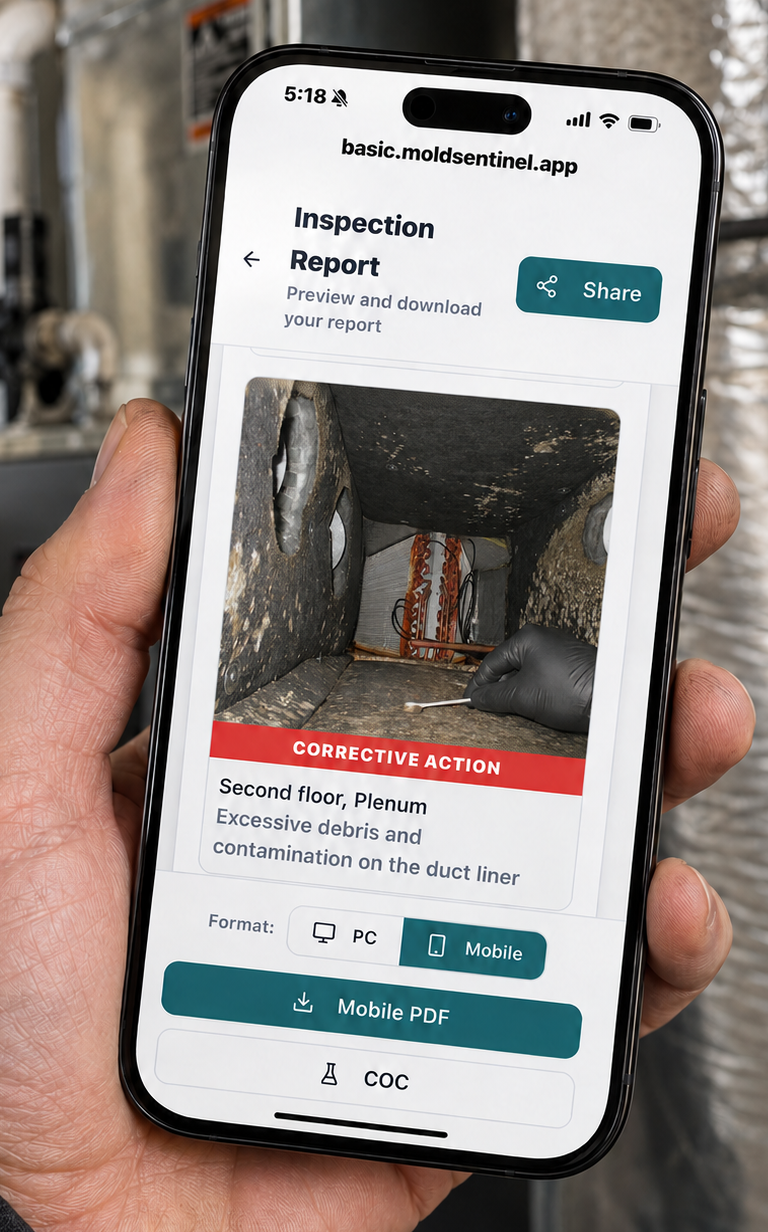
Mold Sentinel phone app guiding the inspection and collecting images for automatic report generation.
Why Mold Sentinel
Three business outcomes that change how you run inspections.
Document once in the field and let Mold Sentinel generate the report before you leave the job site.
Deliver branded, photo-driven homeowner reports and lab-supported HVAC mold documentation.
Turn inspections into testing, repairs, replacements, and ongoing healthy-building relationships.
Save Time
Stop writing reports after hours. Mold Sentinel turns field notes into a finished report while you are still on site.
The Flagship Difference
Mold Sentinel generates two reports from a single inspection: one for the homeowner, one for the lab record. Same data. Two audiences. Higher standard.
Onsight AI-assisted report generation: photos and recommendations instantly generated for technician review before sending to homeowner.
 Find
 Fix
 Prevent
Same-day, photo-driven report that turns technical findings into clear next steps homeowners can act on.
Builds trust, reduces callbacks, and helps close corrective-action work faster.
Technical, sample-backed, and defensible.
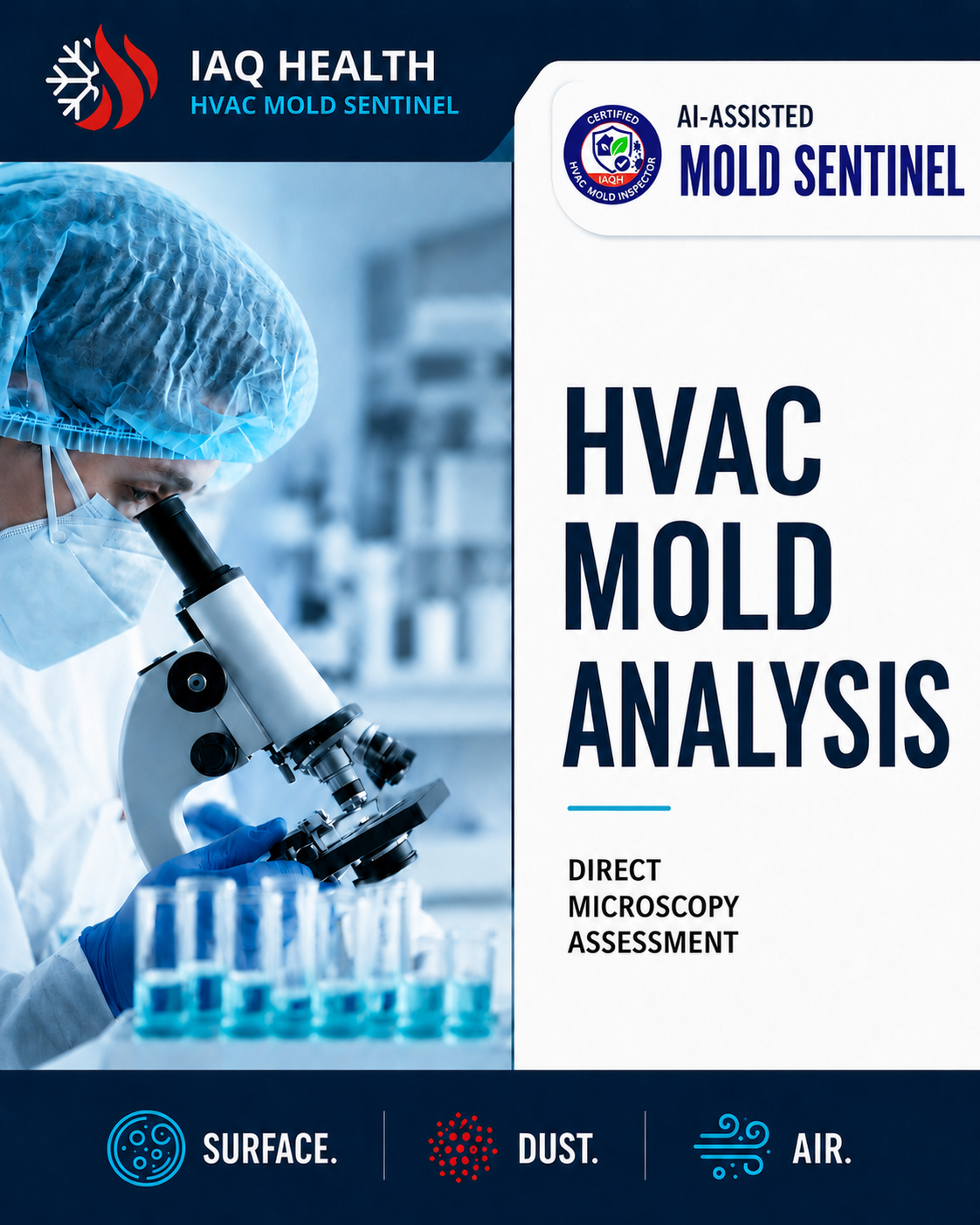
HVAC Mold Report with integrated laboratory analysis. The lab report is supporting evidence, not a third report.
Supports professional credibility, third-party verification, and defensible documentation.
The IAQ Health Method
A consistent, visual workflow from the first walkthrough to the final report. Built for HVAC professionals in the field.

Return, supplies, AHU, plenums, air ducts. A standardized inspection protocol for residential HVAC systems: moisture, filter bypass, duct design, suspect microbial growth, and testing.
Using the Mold Sentinel app, technicians document photos, observations, and recommendations onsite. AI assists with report generation, and the technician reviews and approves the homeowner report before delivery.

Mold samples are shipped to an independent, accredited laboratory for analysis. AI-assisted chain-of-custody form and pre-labeled overnight shipping simplify dispatch and support rapid laboratory turnaround.
Two reports from one inspection: first, a homeowner-friendly Mold Sentinel report; then, a custom HVAC Mold Analysis Report combining the inspection findings with independent laboratory results for technician review and delivery.
For HVAC Professionals
IAQ Health training and Mold Sentinel help you look beyond the coil and drain pan—into plenums, ductwork, boots, and supply registers.
Learn to recognize suspected microbial growth, moisture issues, air leaks, and dust buildup throughout the HVAC system.
Use Mold Sentinel to generate a professional pictorial report from your inspection photos and observations. Review and approve the report, then give homeowners clear findings and recommended next steps.
Documented conditions can reveal the need for:
Greater value from each service visit.
Combine inspection, clear documentation, corrective work, and prevention to help homeowners make informed decisions while creating opportunities for additional service and ongoing maintenance.
Industry Guidance
The IAQH inspection method lines up with guidance from the organizations that set HVAC and indoor air standards.
Sets HVAC design and ventilation standards
ASHRAE recognizes that moisture and accumulated dust can support mold and other microbial growth inside HVAC systems. Its guidance emphasizes moisture control, effective filtration, proper drainage, and access for inspection and cleaning.
Source: ASHRAE position documentsFederal environmental agency
EPA recognizes that moisture in HVAC systems can support mold growth and that spores may enter living spaces. Its guidance calls for correcting the underlying moisture problem, considering cleaning where substantial visible mold is present, and replacing wet or moldy duct insulation.
Source: EPA's guidance on air duct cleaningHVAC cleaning industry association
NADCA recognizes that moisture in HVAC systems can support mold growth. Its guidance emphasizes correcting moisture problems, physically removing contamination, cleaning the entire system rather than ducts alone, and verifying cleanliness.
Source: NADCA ACR StandardTesting
Distinguish mold from look-alike material and investigate evidence of growth within HVAC components.
Compare material entering return ducts, suspect growth inside the system and findings at supply outlets to help understand potential movement into living spaces.
Document findings and inform further investigation or corrective work, including when occupants have mold-related health concerns.
Testing complements inspection and moisture assessment. Surface samples do not prove airborne release, and environmental results do not diagnose illness or establish its cause.
Get Started
Try Mold Sentinel free for 7 days. Complete your first HVAC mold inspection and deliver a professional report before you leave the job site.